


Originally published on LinkedIn - January 31, 2026
The Economic Shift in Code
The fundamental economics of software production are being restructured around a simple principle: the marginal cost of producing working code is collapsing toward zero.
Historically, software was constrained by human cognitive bandwidth. There’s a limit to how much a developer can write, debug, and maintain in a day. Or a sprint. Or a program increment. This constraint is being removed in layers.
Three Layers of Change
Large language models made code generation nearly instantaneous. A developer describes what they want; the model produces it. This alone changed everything but had limits: the human still orchestrates, reviews, and integrates.
Agentic scaffolding added autonomy. Tools like Claude Code, Cursor, and similar CLIs wrap models in loops that can execute code, observe results, and iterate. The human sets a goal; the agent works toward it, handling intermediate steps autonomously. This is where most production use sits today.
Agent swarms take it further. Multiple AI agents work in coordination: specialized agents handle distinct tasks (planning, coding, testing, code review, documentation), orchestration layers break problems into subtasks and route them appropriately, and feedback loops allow agents to critique and iterate on each other’s outputs. This mirrors how human engineering teams operate, but at machine speed and cost. Tools like Conductor let developers run multiple Claude Code agents in parallel, each in an isolated git worktree, with a dashboard showing what each agent is working on. And swarm coordination is now being built into the models themselves: Kimi K2.5, released this week, can self-direct up to 100 sub-agents executing 1,500 tool calls in parallel, with the orchestration learned through reinforcement learning rather than hand-coded.
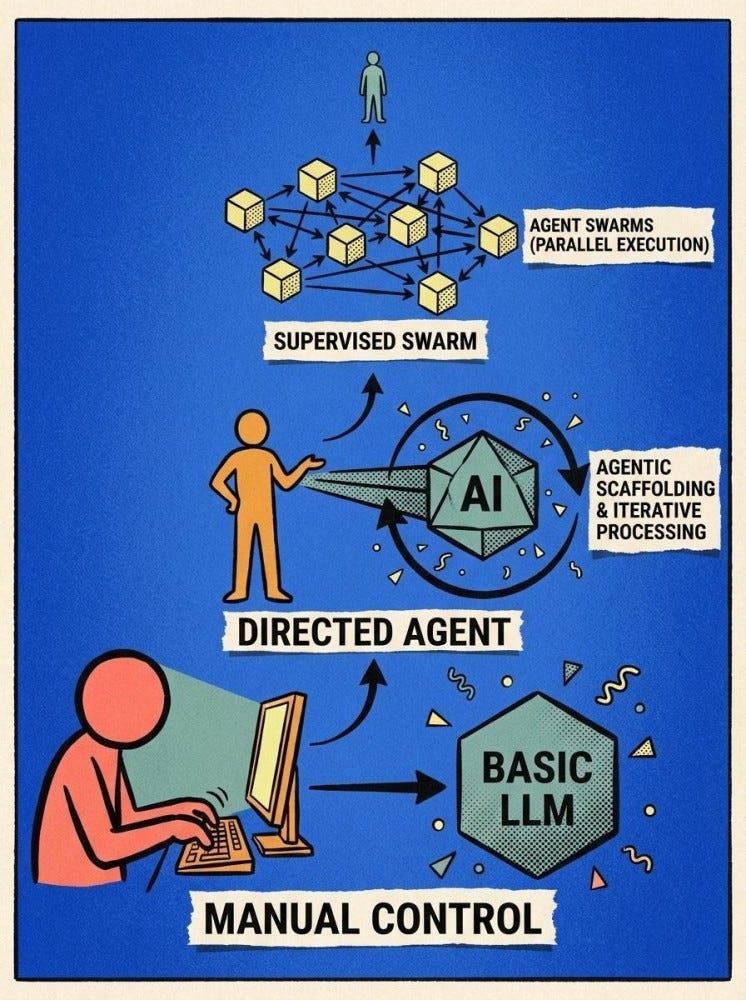
Three layers
The Evidence
This isn’t speculative.
When SWE-bench launched in October 2023, the best AI systems solved under 2% of real-world GitHub issues autonomously. By March 2024, Devin reached 13.86%. It was the first agentic system to show real traction. Today, top systems exceed 75% on SWE-bench Verified.
The improvement came from better models, better tooling, and most importantly, agentic scaffolding that lets AI systems iterate on their own code until tests pass.
AI tools are now building AI tools. Anthropic built Cowork, a general-purpose desktop agent, in approximately ten days, with the code written primarily by Claude Code itself.
Cursor recently demonstrated what sustained autonomous development looks like: hundreds of AI agents running for a week straight, generating three million lines of Rust code for a browser built from scratch. The browser “kind of works.” But the lesson is clear: coordinated, autonomous software development at scale is no longer theoretical.
What Near-Zero Marginal Cost Means
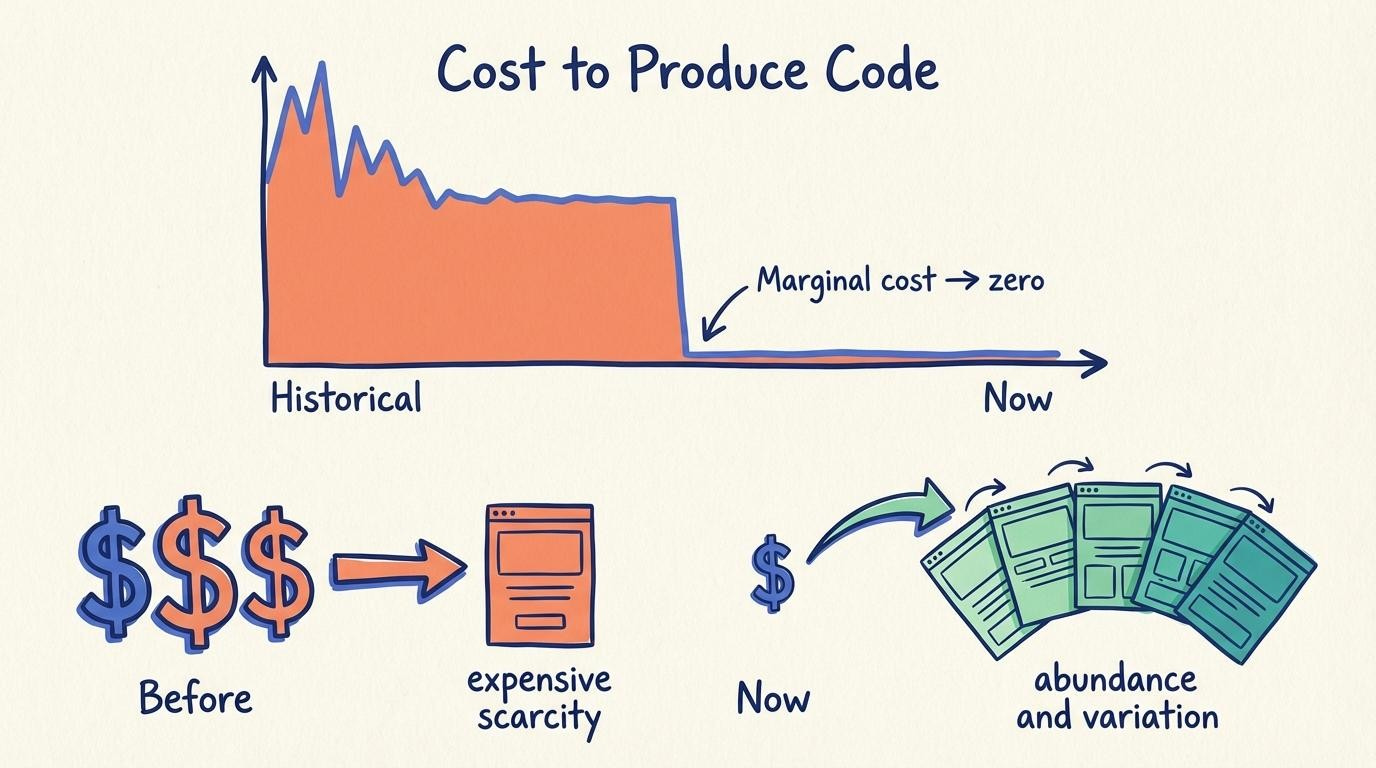
Exploring alternatives becomes cheaper
Exploring alternatives becomes cheaper. You can try three approaches instead of committing to one upfront. Build the feature two different ways and see which performs better. The cost of being wrong early drops dramatically.
First versions come faster. Getting to something testable takes less time. The gap between “idea” and “working prototype” compresses.
The bottleneck shifts from production to specification. When producing code is cheap, the constraint moves to knowing what code to produce. Defining the problem well, specifying the requirements precisely, and understanding what users actually need. Design lives here.
Why This Changes Design
When the cost of a downstream activity collapses, it restructures the purpose and methods of everything upstream.
Design exists upstream of software development. It feeds into it. Traditionally, design served a specific economic function: risk mitigation for expensive downstream work.
The Traditional Logic
The reasoning was straightforward:
Software is expensive to build
Building the wrong thing wastes that investment
Therefore, explore and validate before committing to code
This created an entire methodology: wireframes, prototypes, usability testing, and concept validation. All proxies for the real thing, because the real thing costs too much to build speculatively.
The Inversion
If agent swarms collapse the marginal cost of working software to near-zero, this logic inverts.
Why prototype when you can ship?
Instead of testing a prototype with 8 users, you could deploy actual variants to real users in production. Instead of debating whether users will understand a flow, you could build the candidate flows and measure. Multivariate testing platforms already generate and test hundreds of combinations simultaneously, varying headlines, layouts, CTAs, and imagery across pages. This isn’t A/B testing as we know it. It’s parallel exploration of the solution space.
Stitch Fix offers a glimpse of what this looks like for product generation. Their Outfit Creation Model generates 13 million new outfit combinations every day, trained on millions of stylist-created outfits, considering real-time inventory and client preferences. They’re not prototyping outfit ideas. They’re generating and testing them at a scale no human team could match. This is AI-native product generation, not UI design. But it demonstrates the principle: when generation is cheap, you explore the solution space directly rather than through proxies.
This doesn’t mean prototyping vanishes. Prototypes still have value for rapid conceptual exploration, stakeholder alignment, and situations where production deployment infrastructure is the bottleneck. But the economic logic points toward a shift: the burden of proof moves from “why build this?” to “why not just ship it and learn?”
The New Workflow
This is the direction the economics point toward
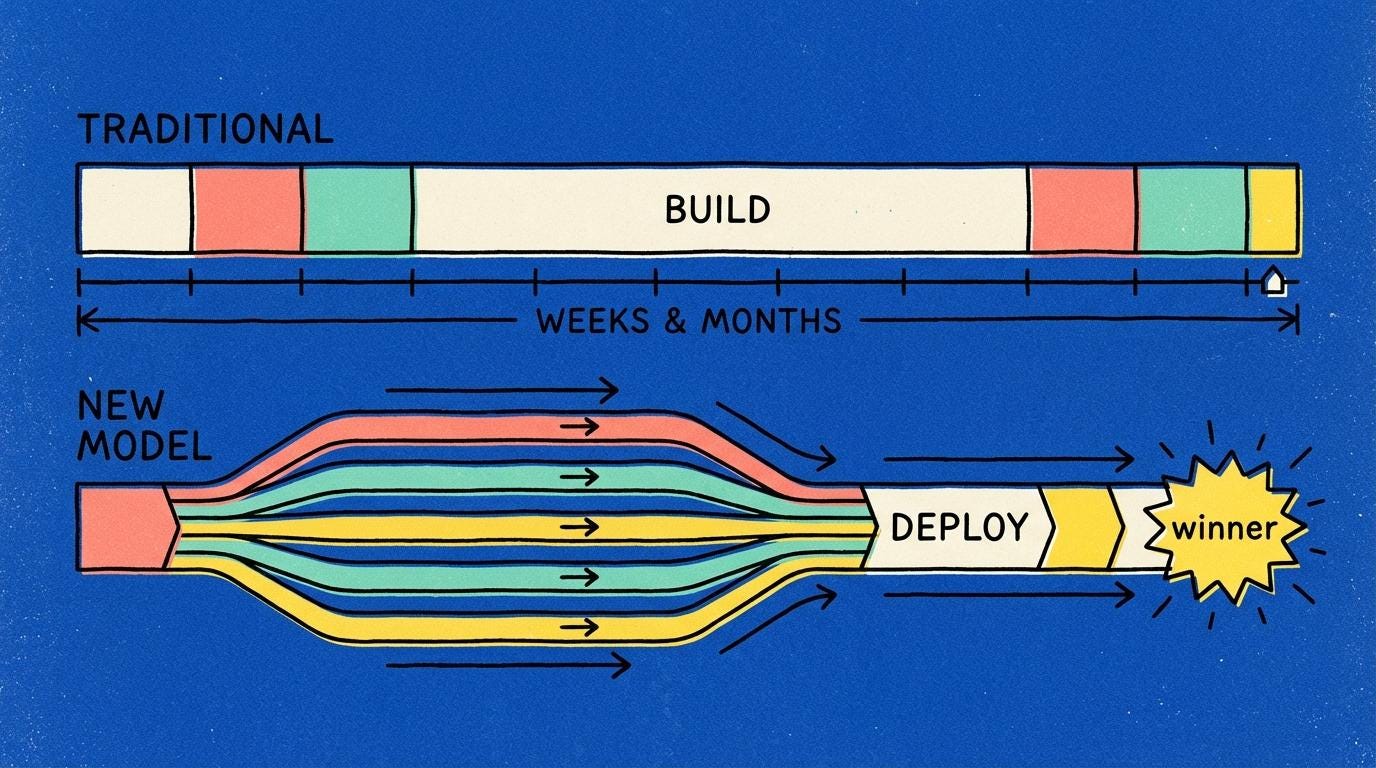
Traditional Design & Build vs New
Traditional
Research → Design → Build → Test
3 concepts tested as prototypes
8-12 research participants
Months of iteration
Zero-Marginal-Cost Model
Define needs → Specify parameters → Generate variants → Deploy → Measure → Converge
Hundreds of combinations tested in production (via multivariate testing)
Real user behavior at scale
Days or weeks
What Design Becomes
As the integration between AI generation and experimentation infrastructure matures, the designer’s role shifts. How quickly this happens depends on how fast the emerging tools become reliable and widespread. But the direction is clear enough to act on now.
For Designers: From Artifacts to Specifications
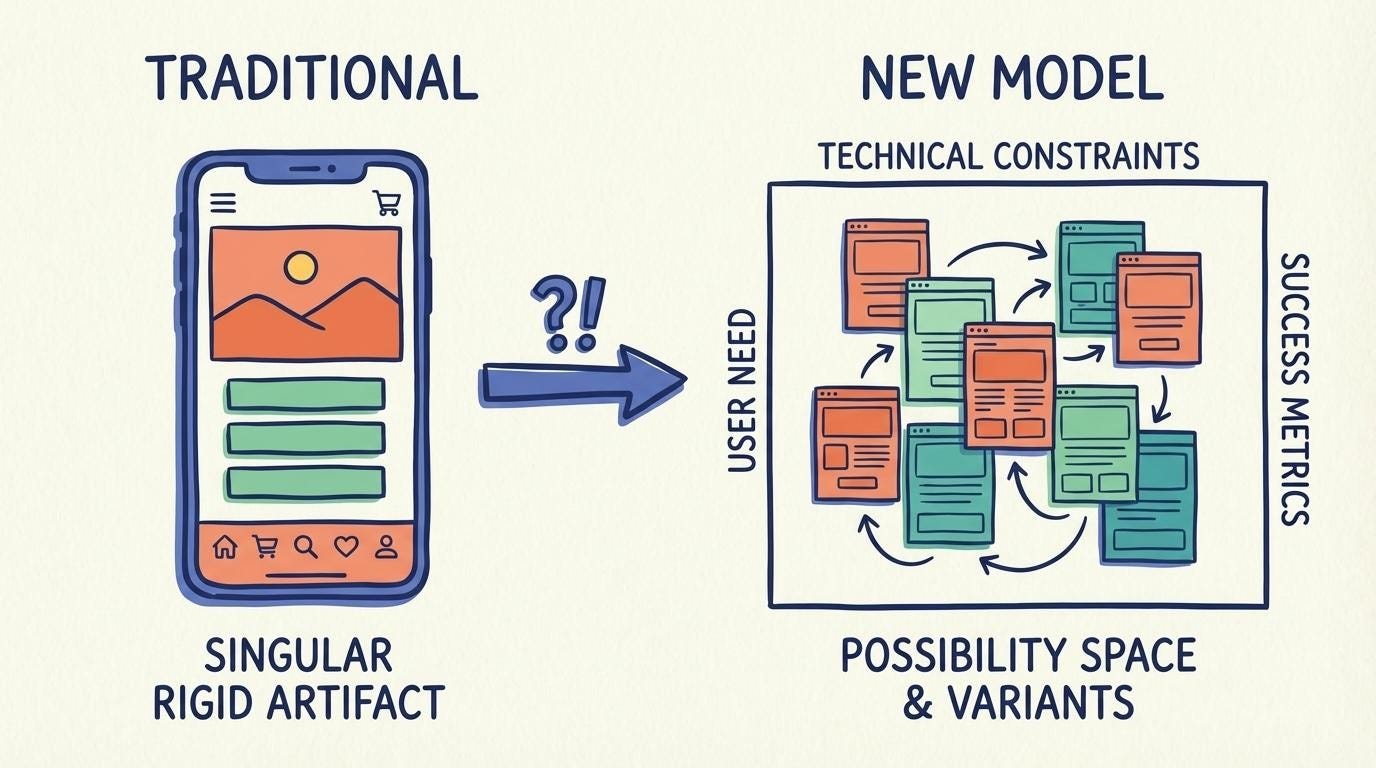
The designer’s core competency is integration: taking inputs from research, business, and technical constraints and synthesizing them into solutions that satisfy all three. That doesn’t change. But when generation becomes cheap, this skill expresses itself differently.
You’re not designing a screen. You’re designing the boundaries of what screens could exist. The output shifts from wireframes and prototypes to specifications that define what a solution must do, what it must never do, and how you’ll know if it worked.
Stop: Spending time on pixel-level execution that can be generated. Treating prototypes as the primary learning vehicle when variants could ship.
Start: Translating research insights and business requirements into specifications precise enough to guide generation. Defining evaluation criteria before variants exist - hat’s the bounding box? Designing experiments, not screens. Define the scope scope of the solution space. The where to explore - the constraints.
Maybe Jensen Huang CEO of NVIDIA said it best.
Captions are auto generated
Play
Smart is someone technically astute but with empathy
“The traditional definition of smart — solving technical problems — is a commodity. That’s the first thing AI solved. The real definition of smart is someone at the intersection of technical ability and human empathy, who can see around corners and preempt problems before they show up — through a combination of data analysis, life experience, wisdom, and sensing other people. That person might score horribly on the SAT.”
Think about it.
For Researchers: The Interpretive Layer
When you can generate anything, knowing what to generate matters more. Researchers own this.
Generative research surfaces human needs and identifies which directions are worth exploring. Before anyone can specify a solution, someone has to understand what users actually need. This doesn’t come from behavioral data. It comes from qualitative work that reveals needs users can’t articulate and opportunities metrics can’t capture.
Interpretive research explains what behavioral data means. When you can deploy hundreds of variants, you get abundant data on what users do. The scarce resource becomes understanding why.
The Booking.com WiFi example illustrates this. It comes from traditional A/B testing, not AI-generated variants, but the lesson applies even more as variant generation scales: quantitative testing of “WiFi Strength - Strong” labels showed no conversion lift. Only through user interviews did researchers discover guests cared about what WiFi enabled (Netflix streaming, email), not signal strength itself. The winning variant was “Fast Netflix Streaming.” Behavioral data alone would have missed this.
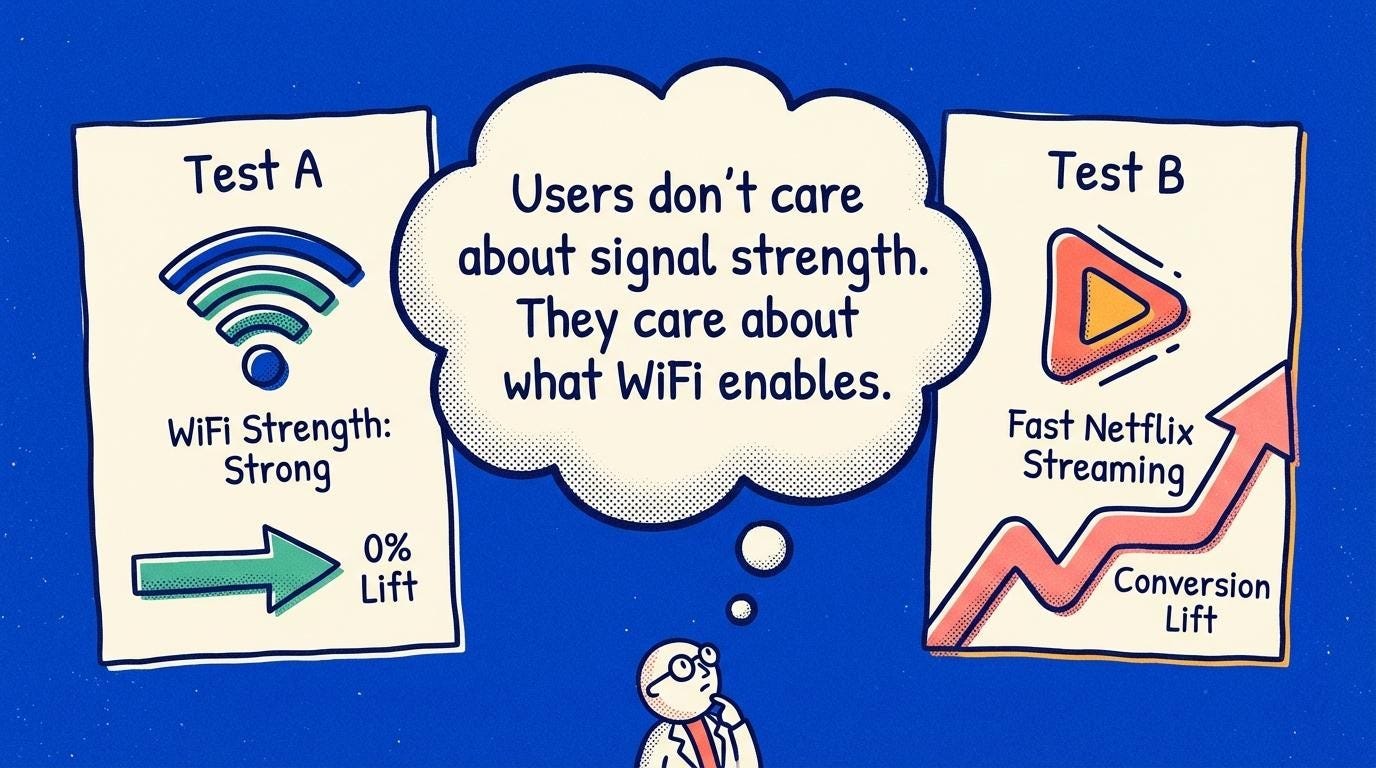
Qualitative insights remain a huge differentiator
Stop treating qualitative and quantitative as sequential phases. Running studies in isolation from live experimentation.
Start: Integrating into the experimentation loop. Identifying which directions are worth exploring before experiments begin. Interpreting what the numbers can’t explain. Being the person who asks, “What’s the WiFi really about?”
The Evidence
Three things need to be true for the thesis of this essay to hold: experimentation at scale must be valuable, AI must be able to generate variants cheaply, and the two must integrate. The first is proven. The second is proven. The third is emerging.
Experimentation at Scale Works
The largest digital companies have already demonstrated that continuous experimentation drives results.
Spotify ($17B) says there is no single Spotify. There’s a version for every user. Their homepage uses multi-armed bandits to balance exploration and exploitation in real-time, continuously testing which content surfaces best for each listener. Their experimentation platform, Confidence, has scaled to over 300 teams running experiments regularly.
Booking.com ($24B) runs 25,000+ A/B tests annually. That’s roughly 70 tests launching every single day, with 1,000 concurrent experiments deployable across 75 countries in under an hour.
Netflix ($39B) runs thousands of streaming experiments per year, with automation enabling engineers to configure, deploy, and analyze tests from a single file.
These companies built their experimentation infrastructure over years, with large engineering teams, before the current AI moment. They prove that experimentation at scale is valuable. They don’t prove that AI is generating the variants. But they set the benchmark: this is what’s possible when you treat every user interaction as a learning opportunity.
The Value Extends Across Revenue Scales
Experimentation isn’t only for companies with hundreds of millions of users.
Electronic Arts ($7.6B) learned through A/B testing that pre-order incentives can backfire. They discovered that certain bonus structures reduced conversions rather than lifting them.
Clarks ($1.1B), the 200-year-old footwear retailer, discovered £2.8 million in hidden annual revenue by testing shipping messaging visibility. Customers weren’t abandoning because of price. They didn’t know how close they were to free shipping.
At $35–50M in revenue, companies like Curiosity Stream and Tea Collection have tested hundreds of variant combinations across key pages, generating measurable revenue lift. Tea Collection’s head of e-commerce said it “created a culture of experimentation across our organization.”
The Experimentation Infrastructure Is Emerging
The experimentation infrastructure exists. The AI generation capability exists. What’s emerging is the connection between them.
VWO has integrated GPT-3.5 to suggest copy variations directly in its visual editor. This is AI-assisted variant creation, though it still requires human selection and deployment. Evolv AI goes further, using machine learning to automatically combine and optimize variants, with newer generative AI features for creating copy and images. P&O Cruises reported achieving “6 years worth of experimentation in 3 months” using Evolv’s platform, testing 72 combinations to find a variant that generated £1.3 million in incremental revenue.
Newer tools like Mida, Keak, and Fibr AI are building explicitly around AI-generated variants. You describe a change in natural language, and the system creates and deploys the experiment. These are early, but they point toward where the integration is heading.
The full realization is not yet widespread: AI that generates variants from specification at machine speed and cost, deploys them to production, measures results, and converges on winners with minimal human intervention. But the trajectory is clear. The companies that connect these pieces will operate differently than those still treating experimentation as a quarterly initiative.
The Hard Problems
Ethical Boundaries
Not everything should be an experiment. Some variants might be manipulative, confusing, or harmful. The speed of generation outpaces the speed of ethical review.
When you can deploy hundreds of variant combinations overnight, governance becomes a bottleneck that can’t be ignored. Ethical constraints must be built into specifications before generation begins.
Infrastructure for Measurement
This model assumes solid systems for deploying variants, tracking outcomes, and converging on winners. Booking.com built this infrastructure over years. But the timeline is compressing: platforms like Evolv AI, VWO, and Webflow Optimize now offer this as a service. A children’s clothing retailer can run 341 variant combinations; a regional bank can triple conversions through systematic testing. The infrastructure that was once a competitive moat is becoming table stakes.
The Risk of Losing Depth
Behavioral data tells you what happened. It doesn’t tell you what to try next. If organizations lean too heavily on generated variants and measured outcomes, they risk losing the deeper understanding that comes from talking to users directly. The researchers who ask “what’s the WiFi really about?” prevent optimization from becoming a local maximum search with no way out.
Conclusion
The economics of code are changing. That much is proven. As production costs collapse, the economic logic points upstream: the value shifts to the work that determines what gets produced.
The full integration of AI generation with experimentation infrastructure is not yet widespread. The pieces exist. Experimentation at scale is proven valuable. AI can generate variants cheaply. The connection between them is emerging. Companies like P&O Cruises and Tea Collection offer early evidence. Tools like VWO, Evolv AI, and newer entrants are building toward this future.
The question is not whether this integration will happen, but when. And for design teams, the question is whether to build the capabilities now or catch up later.
The skills that become more valuable are the ones that remain scarce when generation is cheap: deep understanding of human needs, precise articulation of requirements, and the judgment to know when the numbers are lying.